Showing posts with label recipes. Show all posts

Saturday, February 14, 2026

Dinner Party Recipes

London, England. Early 1980s.

Back in the early 1980s dinner parties were a thing. I moved to London from Oxford in 1979 and fell in with a sociable, fun-loving crowd. As well as going out eating and drinking, theatre and cinema, we also did a lot of dinner parties, taking it in turns to host on a regular basis.

I had a very specific regimen when it was my turn to host. I would leave the flat at 12 noon and walk down to Safeway in Wimbledon High Street, opposite the station, to buy all the ingredients. I would then return to do all the prep, as far as humanly possible, including chopping and slicing the vegetables and putting them in little plastic food bags in the fridge. 

By 5:30 I would be all done and could sit down with a gin and tonic to watch The A Team which was broadcast at that time. That meant by the time my guests arrived I was calm, relaxed and ready to host with minimal panic required in the kitchen and could enjoy more time chatting with my friends.

There was, of course, lots of “You must give me the recipe!” My inbound recipes were recorded on the flyleaf of a cookbook long since gone but I recently discovered in the attic a photocopy of that ancient, bygone flyleaf.

I originally thought of doing a separate post for each recipe with an introduction including a thumbnail biography of the recipe provider but then decided that, given the number of ex-girlfriends on this sheet, it would be ungallant of me. Instead I provide them here unannotated!

John's cheesecake

Base: 

  • digestives
  • muesli
  • 1 oz butter
  • brown sugar

Filling: 

  • 1 carton hazel yoghurt
  • Lg carton double cream
  • Lg carton cream cheese
  • 2 oz icing sugar

Method: 

  • whip cream
  • mix the rest
  • add to cream

Top: 

  • hazelnut 
  • crushed flake

Jeffa's lemon pudding

  • 2 oz butter
  • 2 eggs
  • 4 oz castor sugar.
  • 2 large lemons
  • 2 oz self-raising flour
  • ½ pint milk

Pre-heat oven mark 4 / 350°F / 180°C.

  • Beat sugar, butter & lemon 
  • add egg yolk & beat in 
  • fold in flour milk & lemon juice alternating until all gone 
  • beat egg white to soft peaks then fold in mixture

Cook 40-45 minutes in centre of oven

Sheri's bread

  • 1 pint warm water
  • 1 teaspoon sugar
  • 6 teaspoon dried yeast mix

Leave until frothy

  • 1½ kilo wholewheat flour
  • 4 teaspoon salt
  • 1 tablespoon sugar
  • 2 tablespoon oil
  • 5 oz bran

Mix, add yeast, add 1¼ pint warm water
Knead, leave to double in size
Knock back, leave to rise in tins
Pre-heat oven to 450°C
Cook for approx 40 mins plus 5 mins with bums in the air.

Eve's rum butter

  • ½ lb soft brown sugar
  • ½ teaspoon nutmeg/cinnamon
  • Small glass rum

Mix

  • 4oz butter

Melt (allow to get cooler) 
Beat well with sugar & rum
Chill

Andrea's honey curry chicken

  • 3 oz butter
  • 6 oz clear honey.
  • 12 teaspoon mild curry powder
  • 6 tablespoon german mustard
  • Salt & pepper
  • 8 chicken tits (Andrea says 4 is enough)

Melt everything (except chicken) together until well blended
Put chicken in roasting tin, cover with sauce. 
Cook for 1 hour at 375°f turning once.

Ms London's chocolate roulade

  • 5 eggs
  • 6 oz caster sugar
  • 6 oz dark chocolate
  • Shot of brandy/rum/grand mariner
  • ½ pt double cream
  • Icing sugar

Beat yolks and sugar
Add melted chocolate
Fold into whipped whites
Put in lined greased swiss roll tin
Bake 25 mins at Mark 5/375°F/190°C
Pour liqueur on cool sponge
Spread whipped cream & roll

Stuart’s honey cake

  • 7oz self raising flour
  • 5 oz butter
  • 4 oz soft brown sugar
  • 6 oz honey
  • 1 tbs H2O
  • 2 eggs

Melt butter, sugar, honey, H2O
Cool & beat in eggs
Stir in flour
Bake 45 mins at mark 4

Naomi's gougère

  • ½ pt H2O
  • 4 oz butter
  • 6 oz flour
  • 4 eggs
  • 2 oz gruyere

Melt butter in H2O
Stir in flour
Cool & add eggs
Fold in cheese 
Bake 40 mins

Recipes very much of their time although I might be tempted to give one or two of them a try.

Sunday, November 24, 2024

Aubergine Chocolate Cake

Aubergine chocolate cake

By popular demand, adapted slightly from a Harry Eastwood recipe in “Red Velvet & Chocolate Heartache” [MG = Mary’s adaptation]:

HEARTACHE CHOCOLATE CAKE 

THIS CAKE IS SAD. It's dark and drizzling down the window panes. She puffs her chest in hope when she goes into the oven; she then breaks, like a chest heaving a sob. This is why Aubergine (the Eeyore of the vegetable world) is the right kind of friend to hold your hand.

Ingredients:

  • 2 small whole aubergines (approx 400g)
  • 300g best dark chocolate, broken into squares
  • 50g good-quality cocoa powder, plus extra for dusting
  • 60g ground almonds
  • 3 medium free-range eggs
  • 200g clear honey 
  • 2 tsp baking powder 
  • ¼ teaspoon salt 
  • 1 tablespoon brandy 

Method:

  • Preheat the oven to 180°C. Line a 23cm diameter loose-bottomed tin with baking parchment and lightly brush the base and sides with a little oil [MG - I used a 21cm square dish]
  • Cook the aubergines by puncturing the skins erratically here and there with a skewer, place them in a bowl covered with cling film. Microwave on high for 8 minutes until the vegetables are cooked and limp. Discard any water at the bottom.  [MG - I baked the aubergines in the warm oven for about 40 minutes]
  • Leave the aubergines until they are cool enough to handle 
  • Skin and purée the aubergines in a blender
  • Once the warm aubergine is puréed and smooth, add the chocolate, which will mingle and melt slowly. Set aside, covered once again in cling film, until all the chocolate has melted [MG - I used a bain marie as the chocolate did not all melt]
  • In a large bowl, whisk up all the other ingredients for a minute until well introduced to each other and slightly tipsy (bubbly). 
  • Fold the melted chocolate and aubergine mixture into the bowl with all the other ingredients and mix well
  • Pour the mixture into the prepared tin and place it in the bottom of the oven for 30 to 40 minutes, by which time your kitchen will sing with the smell of hot chocolate.
  • Remove the mixture from the oven and let it cool in its tin for 15 minutes before turning on to a wire rack and peeling off the parchment. Quickly turn the right way up again and sit it on a plate to avoid any scars from the rack.
  • Sieve a little cocoa powder over the top of the cake before cutting yourself a slice

Saturday, May 04, 2024

Cake Salato alle Zucchine [IT]

[Italiano] [English]

Una delle ricette preferite di Mary. Gustoso caldo o freddo. Si congela bene. Funziona bene come ricetta vegetariana aggiungendo più cipolla al posto della pancetta.

Cake Salato alle Zucchine

Ingredienti per 6 persone

  • 180 g di farina bianca "00"
  • 3 zucchine
  • 100 g di pancetta dolce a cubetti 
  • 150 g di ricotta
  • 50 g di pecorino
  • 50 g di parmigiano 
  • 1 cipollotto
  • 3 uova
  • 100 ml di olio di semi di girasole
  • 100 ml di latte
  • 1 bustina di lievito in polvere per torte salate
  • erba cipollina 
  • 10 g di sale

Metodo

1-2-3. Tagliate a cubetti le zucchine e saltatele in padella con li cipollotto. A metà cottura unite la pancetta e cuocete per circa 10 minuti. A fine cottura unite un trito di erba cipollina.


4-5-6. A parte sbattete le uova con li latte e l'olio, unite farina, sale, lievito e formaggi e amalgamate bene li tutto.


7. Unite al composto le zucchine e la pancetta e mescolate ancora.

8-9-10. Versate il tutto in uno stampo da plum cake foderato con carta da forno. Cuocete a 190°C per circa 45 minuti. Servite li cake tiepido o freddo


Da “Una scuola di verdure” a cura di Francesca Badi.  ISBN: 9788861542976.

Savoury Zucchini Cake [EN]

[Italiano] [English]

One of Mary's favourite recipes. Tasty hot or cold. Freezes well. Works well as a vegetarian recipe by adding more onion in place of the bacon.

Savoury Zucchini Cake.

Ingredients for 6 people

  • 180 g of white "00" flour
  • 3 courgettes
  • 100 g diced unsmoked bacon
  • 150 g of ricotta
  • 50 g of pecorino
  • 50 g of parmesan 
  • 1 spring onion
  • 3 eggs
  • 100 ml of sunflower seed oil
  • 100 ml of milk
  • 1 sachet of baking powder for savory cakes
  • chives
  • 10 g of salt

Method

1-2-3. Cut the courgettes into cubes and sauté them in the pan with the spring onion. Halfway through cooking, add the bacon and cook for about 10 minutes. At the end of cooking, add chopped chives.


4-5-6. Separately, beat the eggs with the milk and oil, add the flour, salt, baking powder and cheese and mix everything well.


7. Add the courgettes and bacon to the mixture and mix again.

8-9-10. Pour everything into a 2lb loaf tin lined with baking paper. Cook at 190°C for about 45 minutes. Serve the cake warm or cold


From  “a Scuola di Verdure” edited by Francesca Badi. ISBN: 9788861542976.

Saturday, December 26, 2020

Christmas Pudding

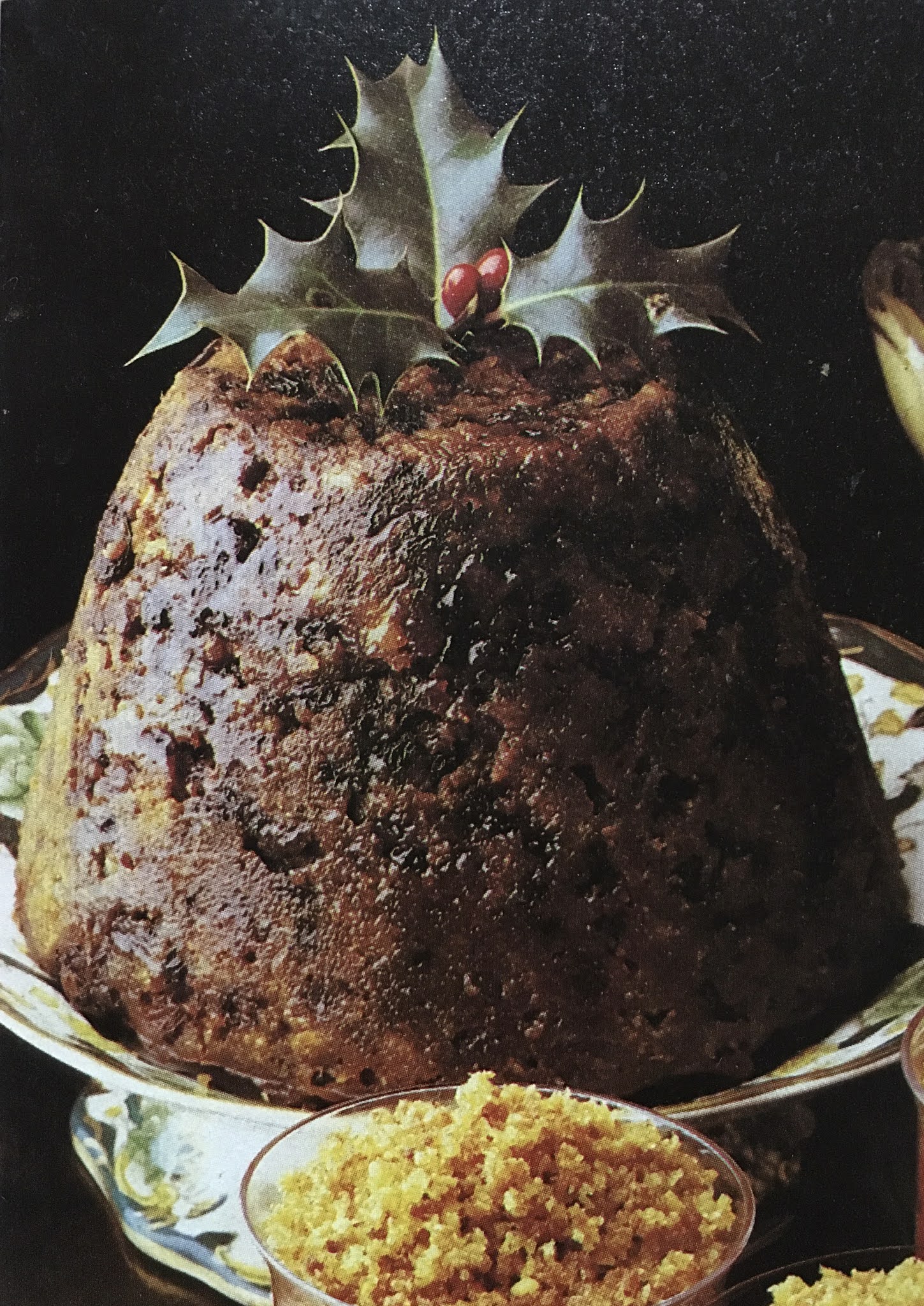
For years Mary has made this delicious, vegetarian Christmas pudding from an ancient Sainsbury Book of Puddings and Desserts by Carole Handslip, one of a brilliant series of small format hardbacks that Sainsbury published around 1980. You can make this diary free by substituting a vegetable fat, such as TREX, for the butter.

Christmas Pudding

175 g (6 oz) plain flour
2 teaspoons ground mixed spice
1 teaspoon ground cinnamon
2 teaspoon grated nutmeg
175 g (6 oz) fresh white breadcrumbs
175 g (6 oz) butter
175 g (6 oz) soft brown sugar
350 g (12 oz) sultanas
250 g (8 oz) raisins
250 g (8 oz) currants
75 g (3 oz) chopped mixed peel
grated rind and juice of 1 orange
2 eggs, beaten
120 ml (4 fl oz) brown ale

Sift the flour and spices into a bowl, add the breadcrumbs, then rub in the butter. Stir in the sugar, add the remaining ingredients and mix thoroughly.

Turn into a greased 1.75 litre (3 pint) pudding basin, cover with a pudding cloth or greaseproof paper and foil, and steam for 6 hours, topping up the pan with boiling water as necessary.

Cool slightly, then remove the cloth or paper and leave to cool completely. Cover with clean greaseproof paper and foil and store in a cool dry place.

To serve, steam the pudding again for 2 to 2 1/2 hours. Turn out onto a warmed serving dish. If liked, pour over 2 to 3 tablespoons warmed brandy and ignite. Top with a sprig of holly and serve with cream or Brandy Butter.

Serves 8 to 10

NOTE: Christmas Pudding improves with keeping as it allows the mixture to mature. If possible, make it 3 to 4 months before Christmas.

© Cathay Books 1980

Friday, November 27, 2020

My Life In ... Recipes

The eighth in an occasional series of alternative Curriculum Vitae because no-one on their death bed says "I wish I'd spent more time in the office".

As a bachelor for many years it was a case of "cook or starve". My hey-day for cooking was the 80's when I held regular dinner parties. My normal routine was to head off to the supermarket at high noon to do the shopping. I would then return and do all the prep including the veg sliced and diced and in bags in the fridge ready to cook so that, as far as possible, I had nothing to prepare when my guests arrived, just cook. At five o'clock I would sit down to relax with a gin and tonic and watch The A Team. When my guests arrived I was chilled and ready to enjoy my own dinner party as all was in order and ready to go.

The following is a long way short of all my favourite recipes but more a case of ones that stuck in the mind, sometimes not always for good reasons!

Unleavened bread (1965): the Boys Own Paper, a periodical from my early childhood, had a regular series of survival articles on how to, for example, escape from a car that had plunged into a river. It was a sort of primitive Ray Mears. One item included improvising a skewer by taking a green twig and stripping the bark to reveal the slippery inside stick. I made some basic unleavened bread mix using flour and water (although where you’re supposed to find a bag of flour in Mirkwood I don’t know). Not having the wherewithal to make fire in the garden my mother let me grill the chewy bread “sausage” in the kitchen. Whether it was edible or not I have no memory.

Crab Apple jelly (1967): in the nearby woods there was a crab apple tree where I scrumped a whole bagful of small, golfball sized apples. Boiled up they actually did produce a very palatable, lovely, pink jelly suitable for spreading on toast. Delicious and food for free!

Vesta Chow Mein (1973): Like many people, college was my first serious, needs-driven introduction to cooking. For the first two years at college I had no access to a kitchen in the accommodation where I lived so ate either in the college dining room or in the White horse pub (always pasty and beans). When I moved into a shared house in my third year I had to start the process of learning to cook. A regular was Vesta ready meals, not exactly cooking from scratch. I read that they deliberately tweaked the recipe every so often to prevent people from getting bored and so would come back for more.

Rabbit in Cider (1973): We had a party in the shared house where we served scrumpy brought up from Somerset by one of our friends, Vincent Russett. That Christmas I was given my first ever cook book by my sister's German boyfriend. One of the recipes was rabbit in cider so we thought we would give it a go. We went off to the covered market where we bought a whole rabbit which we asked the butcher to behead and skin and gut. We got it home and had no idea how to fillet it so Vince and Pete got out their dissecting kits and we dismantled the corpse. The resulting pieces of meat went into the cider and it turned out very tasty for my first ever attempt at real cooking.

Coq au Vin and Hertford Pudding (1974): Inspired by the success of the rabbit in cider, my three friends and I decided to host a dinner party for our college tutor. Coq au vin for the main course. We studied at Hertford College and so when I discovered a recipe called Hertford pudding it was a no-brainer what to serve for desert. It is simply chestnut purée flavoured with a little whiskey, stirred into whipped double cream to give a marbled effect and served in a wine glass, my first sophisticated pudding.

Mung Bean Moussaka (1975): After graduation my cooking repertoire expanded. I was introduced to The Cookery Year cookbook by Reader’s Digest and most of my culinary firsts came out of that including moussaka. I had the ingredients purchased and the aubergines all salted and sweated when suddenly two vegetarian friends were added to the guest list. Momentary panic then inspiration: substitute mung beans for mince, they would provide a similar granular texture to that of mince. So I soaked some beans and carried on as if nothing had happened. I was well pleased with my cunning improvisation.

Pheasant in cream and brandy (1976): After I started work I moved in with Lorna and Carmichael as their lodger. I bought a couple of pheasants from the same game butcher as the rabbit and following the recipe browned them in a ridiculous quantity of butter. The next step was to flambé with brandy rather like a Christmas pudding. I poured in a tablespoon of brandy, set light to it and it went out. So I repeated the process, same result. Once more, ditto. So I warmed up the pan, set fire to the brandy in the spoon, tipped it in and, Hey Presto, a pillar of fire of biblical proportions! Don’t panic Mr Mainwaring!! When the flames subsided I poured in a whole tub of cream. Healthy it wasn’t but delicious it certainly was.

Hungarian goulash (1976): I was making a basic beef stew when I decided to experiment a little. Some variations of goulash and borscht include sour cream. Some dishes mix meat and fruit like duck a l'orange and gammon and pineapple. I didn’t have any sour cream but I did have a tub of black cherry yoghurt in the fridge. So, in a spirit of experimentation, I decided to add some into the stew. Unfortunately the yoghurt was past its sell-by date and had started to bubble a little so maybe it wasn't such a good idea. Alas the result was inedible and the stew wasted. Lesson learned!

Salty bread (1977): I started making my own bread following the recipe in The Cookery Year. Unfortunately there was a misprint so instead of 1 teaspoon of salt I added 1 tablespoon of salt. Of course as a novice bread maker I did not spot the typo. The first loaf went in the bin but the recipe was annotated and it got better after that I’m glad to say.

Birthday cake (1979): My first year in London was working in Sainsbury's head office and commuting in from the culinary desert that is North Acton. I invited a young lady round for dinner to celebrate her birthday. I decide to bake a rich fruit cake with icing and, as a novice baker, followed the recipe literally. It said cover it with marzipan so I did exactly what it said, I covered ALL sides including the bottom. Of course it stuck the circular breadboard I had been using as a base so I decided to cut it off using the breadknife. Inverting the whole assembly on the outstretched fingers of my left hand I quickly realised it wasn't going to work as the the weight of the cake sank it onto my fingers making holes like a bowling ball. I quickly flipped it back, smoothed the marzipan over the holes and iced the whole thing as if the breadboard had always been my "serving suggestion".

Crème brûlée (1990): One of my signature dishes this time thanks to a misreading, not a misprint. The recipe said 2 x 284ml (10 fl oz) and I read that as "10 fl oz" not "2 x 10 fl oz". So basically I used half the amount of cream with the result that the creme part was particularly rich. Once I discovered the misprint I decided to carry on making it ultra rich using 20fl oz and twice the number of egg yolks.

Peppers and capers (1991): a Carluccio recipe that I make regularly, often when we have pork chops or escalopes for which it is a perfect accompaniment. Even when Mary is cooking it is always my task to make this.


Gumbo (1998): Mary and I learnt how to make Gumbo at the New Orleans School of Cooking during our first visit to the jazz fest. Making the dark roux requires patience, manual dexterity and nerves of steel so I get the job of setting off the smoke detector whenever we have gumbo.

Nowadays Mary does almost all of the cooking while I act as commis chef, dishwasher operator, wine decanter and wine glass hand-washer.

Thursday, April 28, 2016

Limoncello recipe

Our friend Christine makes an excellent limoncello, not too sweet. This is her recipe:

Ingredients
  • 400 ml alcohol
  • 5 lemons (unwaxed)
  • 500 ml water
  • 200 gm sugar
Method
  • Remove the zest from the lemons
  • Put the zest in a jar with the alcohol
  • Leave in the dark for 15 days
  • Strain out the zest
  • Dissolve the sugar in the water
  • Combine the sugar syrup with the alcohol
  • Leave in the dark for one month
  • Drink
Not being sure of the lemons in the market we stole five lemons from Chris's tree (with her permission). Guaranteed unwaxed and pesticide free.


One unusual feature of Italian supermarkets compared to the UK is that you can buy pure alcohol (95%) for culinary purposes in just about any store. Some recipes suggest using vodka, if neat alcohol is not available, but that will be 30% water so you would only need about 300 ml of the sugar syrup to keep the ratio of alcohol to water correct.


Then all you need is a jar or two and a zester. You could use a knife but a zester allows you to precision de-rind the lemon without any bitter pith.


Two weeks later and the alcohol has leached out the oils and flavours from the zest.


Chris's recipe only uses 200 gm of sugar but some I found on the internet that used nearly 5 times that amount! If it is too tart you can always add more sugar later but you cannot take it out if there is too much.


The combination of the water and the oils makes limoncello turn the typically cloudy appearance.


Now all I have to do is let it mature in the dark ready for our next visit.

Update: After five years I tweaked the recipe reducing the alcohol from 500 ml to 400 ml. It was a bit too fiery and the syrup came out at about 600 ml so the final mix wouldn’t fit in a 1 litre bottle which bugged me. Now it’s just right, to my taste. 
Also I have been experimenting with orange-cello and lime-cello. The orange version is now my go-to recipe as we are frequently offered limoncello in restaurants here in Puglia and it is nice to have something different at home. Using soft brown sugar or Demerara sugar for the syrup gives it a distinctly marmalade-like flavour.

Thursday, November 08, 2012

Carrot and orange cake

Two Weight Watchers points per serving
25 minutes to prepare + cooling
40 minutes to cook
Makes 10 slices
  • Low fat cooking spray
  • 125g (4 1/2oz) stoned dried dates
  • 1 tsp ground cinnamon
  • 1/2 tsp ground mixed spice
  • 100g (3 1/2oz) pineapple chunks in juice, drained
  • 250g (9oz) self raising flour
  • 1 tsp baking powder
  • 1 tsp bicarbonate of soda
  • 100g (3 1/2oz) carrots, coarsely grated
  • Zest and juice of 1 orange
  • 2 eggs, beaten
  • 25g (1oz) icing sugar
1. Preheat the oven to gas mark 4 / 180°C / fan oven 160°C. Spray a 
20cm (8in) square cake tin with low fat spray and line the bottom
 and sides with baking parchment. Set aside.

2. Put the dates and spices in a small pan with 200ml (7fl oz) water 
and bring to a simmer over a medium heat. Continue to simmer for 
5 minutes until the dates are soft, then set aside to cool. Meanwhile,
 blitz the pineapple chunks briefly with a hand-held blender until 
roughly pureed. Set aside. Puree the cooled dates until smooth.


3. Sift the flour, baking powder and bicarbonate of soda into a bowl.
Stir in the pineapple, pureed dates, carrots, orange zest, juice of 1/2 the orange and the eggs. Beat until combined then pour into the
 cake tin. Bake for about 30 minutes, or until firm and springy to the
 touch. Allow to cool in the tin.

4. Remove the cake from the tin and take off the paper. Add enough of the remaining orange juice to the icing sugar to make smooth 
icing. Drizzle over the cake and leave to set. Slice into 10 pieces and store in an airtight container for 2-3 days.

Friday, February 24, 2012

Recipe for Clootie Dumpling

Clootie dumpling unwrapped

A Doric alternative to May's Dumpling Recipe

punna self-raisin' floour
punna currants an' a haunfa o' raisins
quanera punna suet
haufa punna granulatit sugar
fower wee teaspoonsfa o' mixed spice
a big pincha saut
some mulk
  • Rummle up the hale jing-bang in the boul, addin' a wee tate mulk so's ye get a dough that's stiff an' no' runny.
  • Tim some bilin' watter oot the kettle inty the fit o' the basin an' spread the cloath (or cloot) oan tap o' the watter.
  • Cowp the hale o' yur dough oot the boul an' oan tae the cloot in the basin.
  • Draw the coarnurs o' the cloot the gither an' tie wi' the string.
  • Don't tie the string too tight or the dumplin' might burst efter swellin up an' ye'll be in a helluva mess.
  • Noo ye've a big bag o' dough aboot the size o' a fitba'.
  • Nixt ye pit a plate in the fit o' the big poat. Then gently ye lower the dumplin' oan tae the plate.
  • Efter that poor as much bilin' watter inty the poat as will cover yur dumplin'.
  • Efter a' this cairry-oan ye'll mibbe waant a cuppa tea an' a fag. or even a wee lie-doon.
  • Anyway, whitivvur ye dae, dinny let the dumplin' simmer fur mair than three-an'-a-hauf oors.
  • Efter that time wheech it oot the poat an' oan tae a plate.
  • Peel aff the cloot an' therr ye huv a dish fit tae set afore a dizzen Egon Thingmys.

Saturday, October 15, 2011

Clootie Dumpling

Whenever there is a birthday in the family Mary's mum, May, makes a clootie dumpling to celebrate. Since it was my birthday in the week preceding our last visit I got the traditional alternative to a birthday cake.

Clootie dumpling in the pan

Clootie dumpling out of the pan

Clootie dumpling unwrapped

There are many variations on the Clootie Dumpling recipe - this is May's version.

Clootie Dumpling recipe

1 1/2 lb Self Raising Flour
6oz Currants
6oz Sultanas
3 teaspoons Cinnamon
3 teaspoons Ground Ginger
3 teaspoons Mixed Spice
3 dessertspoons Treacle
3 dessertspoons Syrup
3oz vegetable suet
3oz caster sugar
1/2 pint milk (approx)

Mix dry ingredients, add treacle and syrup.
Mix until moist with milk.
Add fruit and stir through
Scald cloth with boiling water, sprinkle with SR flour
Place dumpling mixture in centre of cloth
Tie cloth with string leaving room for expansion

Steam for 3 hours.
Remove cloth, place dumpling on plate and dry in oven (100C for 15 minutes)

Monday, September 14, 2009

Smoked Mackerel Pate with Cucumber Relish

This recipe Mary acquired at a Saturday cookery school some years ago. It never fails to be a crowd pleaser and so easy-peasy to prepare. Certainly there was none left after Saturday's BBQ.

SMOKED MACKEREL PATE

8 oz smoked mackerel fillets
pinch ground mace or nutmeg
1 oz butter (melted)
8 oz curd cheese
pepper to taste
few drops lemon juice
Tabasco or little cayenne pepper

Remove skin and bones from fish, pound to a smooth paste with the mace, work in remaining ingredients

CUCUMBER RELISH

1 cucumber (sliced)
2 tbsp wine vinegar
1 tsp dry mustard
6 tbsp salad oil
3 dsp tomato ketchup
1 tbsp chopped fresh mixed herbs (parsley, chives, mint)
salt and black pepper

Combine dressing ingredients, spoon over cucumber, chill well before serving

Friday, August 14, 2009

Bircher muesli with summer berries

This recipe we first came across as part of our preparation for the London to Paris bike ride. Like pasta before a marathon it is slow release carbs. However it is so tasty we now make it simply to the pleasure of it.


A breakfast treat that's good for you and a fantastic summer alternative for porridge lovers.

Serves: 2
Preparation time: 15 minutes plus overnight soaking


Ingredients
  • 100g whole rolled jumbo oats
  • 100ml skimmed milk
  • 50ml cloudy apple juice
  • 1 tbsp sultanas
  • 1 tbsp chopped dried apricot
  • 100g mixed summer berries
  • Pinch of sugar
  • 1 tsp pumpkin seeds
  • 1 tsp sunflower seeds
  • 2 tsp chopped mixed nuts
  • 1/4 apple, cut into lcm approx pieces
  • 4 tbsp natural yoghurt
  • 1 tbsp honey

Method
  1. Put the oats in a bowl and pour over the milk and apple juice. Stir in the sultanas and apricot pieces. Cover and leave in the fridge overnight.
  2. Put the berries in a saucepan, add the sugar and heat through the mixture until the berries have begun to break down, Pour the compote into a bowl and allow to cool. Cover and leave in the fridge overnight.
  3. The following morning, stir through the seeds, nuts, apple, yoghurt and honey.
  4. Divide the muesli between two bowls, add a dollop of the compote and serve.


bircher meusli
Cook's Tip
If you prefer, simply sprinkle the berries on top of the muesli instead of making the compote. Alternatively, serve with the fruit of your choice - mango is delicious. This muesli still tastes great the day after, if you have any left.

www.cyclingweekly.co.uk

Tuesday, June 23, 2009

Baked Coriander Cod

2 tablespoons finely chopped fresh coriander
1 teaspoon grated fresh ginger
1 garlic clove, crushed
10 freeze dried curry Leaves, crushed
25 g (1 oz) creamed coconut, grated
4 x 125 g (4 1/2 oz) skinless cod loin fillets
Salt and freshly ground black pepper

Serves 4. Takes 18 minutes.

1) Preheat the oven to Gas Mark 5 / 190°C / fan oven 170°C and then put a baking tray or oven proof dish in the oven to heat. In a bowl, mix together the coriander, ginger, garlic, curry leaves and coconut, then season.

2) Place the cod loin fillets on a board and press a little of the coriander mixture on to each fillet. Remove the baking tray or ovenproof dish from the oven, transfer the cod and bake in the oven for 10 minutes until cooked. Serve immediately.

Tuesday, March 03, 2009

Lentil soup so thick...

...you could stand your spoon up in it.

Mary made a batch of lentil soup on Sunday using a recipe from The Soup Kitchen. I gave it a stir and thought "A spoon would stand up in this" so I did.

It stayed there long enough for me to run upstairs and grab my camera and run back down again:

lentil soup with spoon standing up in it

Need need for CGI trickery here!

Friday, October 05, 2007

Sunday, September 23, 2007: Cookery School Starts

Sunday was the start of the cookery school. Mino was in Wales at a food expo promoting Puglian food so we had Sunday lunch at his sister Zia's house. She fired up the pizza oven and we did a number of flour based dishes: focaccia, orecchietti, something else and then a tiedda (hotpot) of chicken and potatoes.

Zia and a forno a legno (wood burning oven)

It was all conducted in Italian as Zia has very little English which was good fun. Then we sat down with her family for Sunday lunch - it was a privilege to be invited into her home and family.

Zia and Mino also appeared on the BBC series "Rick Stein's Mediterranean Escape" in the same Puglian episode as Rosa:

Zia, Rick Stein and Mino Maggi *

This was where the rest of the course was held. More tomorrow...

* Buy the book from Amazon

Tuesday, September 04, 2007

Fried Peppers with Garlic, Capers and Vinegar

This is one of Mary's favorite recipes so it has become one of my signature dishes. I make it regularly especially when in Italy (see "Our first dinner party"). It is excellent with barbecued chicken.

It is also, like Panzanella, a fine example of a "Traffic Light Meal". For the benefit of Americans 800gm is four bell peppers (I aim for two red, two yellow, never green - the capers do that).

Fried Peppers with Garlic, Capers and Vinegar

Fried Peppers with Garlic, Capers and Vinegar
from one of Carluccio's recipe books.

Serves 4-6

800 g (1 ¾ lb) whole red and yellow bell peppers
4 cloves garlic
1 tbs salted capers (alternatively capers in vinegar)
4 tbs olive oil
2 tbs wine vinegar
salt

Cut the peppers into strips. Slice the garlic and put the capers to soak in a bowl of water. Heat the oil in a large frying pan and fry the strips of pepper. The oil should be quite hot. Stir while frying the peppers: their skins should begin to scorch at the edges. Then add the slices of garlic and the capers, drained and dried before being added. While these ingredients are sizzling, add the vinegar and salt, stir well and let the vinegar evaporate for a minute. Serve immediately if you like, but an excellent dish cold.

Monday, July 09, 2007

If life gives you cherries...

...make cherry jam.


Market Stall


One of the fun features of any foreign land is the visit to the market. We are midway between Cisternino, market day Monday, and Locorotondo, market day Friday. So we have done a lot of wandering around the markets admiring the local fresh produce and the ludicrously cheap clothing and housewares.


Mary at a Market Stall

One old boy was selling cherries and it was the end of the day. We asked for mezzo kilo (just over a pound weight) but he kept piling them in the bag despite our cries of "basta!" (enough!). We ended up with 2 kilo (4½ pound) for 5 Euro.


Cherries before triage and stoning

What to do? We couldn't eat that many. So Mary consulted her Italian cook books and found "ciliegie sotto spirito" (cherries in alcohol) and I googled a cherry jam recipe in the internet cafe.

First step was to separate into eating, cooking and chucking. The alcoholic recipe was easy. Buy neat alcohol in the supermarket (not something you can do in the UK, maybe use gin or vodka instead), bung in some cinnamon stick, a couple of cloves and a spoonful of sugar then cover with alcohol.


Cherries under alcohol

The jam was not so successful because I chucked the sugar in then read the recipe which said boil the fruit first *then* add the sugar. I removed as much as I could and proceeded as instructed but I ended up with something more like cherries in syrup than jam. Still it was very tasty spread on toast so I'm happy.

Wednesday, December 20, 2006

Creme Brulee

Following my mention of Crème Brûlée in Five things to eat before I die here is my version.

The following is the recipe exactly as it appears in my Sainsbury's Desserts and Puddings recipe book. Why they felt the need to specify the carton size I do not know. Since they did, what they should have done is write "2 x 284 ml (2 x 10 fl oz)" or better yet simply "568 ml (20 fl oz)". Using 1 x 284 ml (1 x 10 fl oz) meant this only just served 4.

Nowadays what I normally do is use the full amount of cream, increase the number of egg yolks to 6 and still regard it as "serves 6". Also I don't use vanilla essence, I cut open a vanilla pod and scrape all the black gooey seeds into the custard making sure to disperse them as best I can.

As for chilling overnight I wish I planned that far ahead. Normally I make them that day, chill them until it is time to prepare the rest of the dinner, brûlée them, pop them back in the fridge and hope my guests don't eat too fast so they have time to cool down again.

Crème Brûlée

4 egg yolks
1 tablespoon caster sugar
2 x 284 ml (10 fl oz) cartons double cream
few drops of vanilla essence

To finish:
50 g (2 oz) caster sugar

Beat the egg yolks and sugar together. Warm the cream in a double saucepan, or bowl over a pan of simmering water. Carefully stir in the egg mixture. Continue cooking gently, stirring constantly, until thickened enough to coat the back of a spoon. Add the vanilla essence.

Strain into 6 ramekin dishes and place in a roasting pan, containing 2.5 cm (1 inch) water. Place in a preheated cool oven, 140°C (275°F), Gas Mark 1, for 30 to 40 minutes.

Remove the dishes from the pan, cool then chill in the refrigerator overnight.

To finish: Sprinkle evenly with sugar. Place under a preheated hot grill until the sugar has caramelized. Cool, then chill in the refrigerator for 2 hours before serving.

Serves 6

Enjoy

Monday, August 14, 2006

Traffic Light Meals

Last Tuesday I caught the train straight from work down to Farnborough for a Nepalese meal. I met up with Bob Carlsen, my old boss from CSC, in the Gurkha Palace together with four other ex-colleagues. The company was fine as was the food. Well, flavour wise it was fine but visually it was very monchrome, very beige: rice, naan and an assortment of curries all in shades of brown. Colour is important in food presentation.

Years ago, when I was single, I would veg out on a Sunday morning watching the OU. One time there was this Fine Arts lecturer explaining how Constable would always use a small dot of red somewhere in his pictures; in "Flatford Mill" it is on the headband of the horse. Even a small dash of contrasting colour can bring vivacity to a visual image. If you ever get your portrait drawn by a street artist notice how they often apply a dot of white in each eye to give the face more life.

Making the connection, like you do, I realised this is the purpose of the garnish on a plate. I had never been able to see the point of embellishing, say, a starter of toast and pate with two scraps of lettuce and a quarter tomato; not much in the way of nourishment there but of course it is meant as a feast for the eyes.

More specifically an easy way to give your meals visual appeal is to adopt a traffic light scheme: red, amber, green. Not always literally, the place of red might be taken by brown grilled meat and the amber might be a white slice of mozarella; adapt the basic schema to the meal in mind.

For example my meal last week at the Cork&Bottle was grilled giant prawns (red) on a bed of salad (green) and it needed the slice of lemon to give the dish the amber lift. Likewises Kylie's sausage (red) and chips (amber) needed the tomato to give it the red boost.

Two out of three just and something is missing. That is why red (bell) peppers and tomatoes are so useful; carrots also can play red or amber depending on the rest of the plate. Of course some meals are there already like "insalata tricolore" - tomato, mozzarella and basil or the panzanella Mary made at the weekend.

[Panzanella recipe from BBC Good Food]

Thursday, February 23, 2006

My cup runneth over

At the start of the year Rosa blogged a recipe for "Hoppin John". As a Brit, I had never heard of such a dish which sent me rushing to Google to find out more about this traditional Southern US dish.

One question I have of Rosa, or anyone else who cares to answer, is why do Americans use Cups in their recipes? What is wrong with weights for solids and measures for liquids? A cup of a solid ingredient seems so imprecise (although I know cooking is an art not a science).

My theory is that in the pioneering days of the wild west the early settlers did not have access to sophisticated European devices like scales and graduated jugs so they made do with the basic kitchenware they had to hand.

Working from US cookbooks causes me a problem. How much is a cup? A typical UK recipe will quote both Imperial and Metric units, the conversion factors for which are well known and precise. As far as I can tell a cup is 8 fluid ounces or 240 ml (rounding a bit, in fact 1 fl oz = 28 ml not 30). So that will do for me.